
Introduction
Every gamer wants smooth gameplay without annoying stutters, lag, or frame drops. Whether you’re playing competitive shooters, open-world adventures, racing games, or RPGs, higher frame rates can make your gaming experience significantly better. If you’ve been searching for practical ways to increase FPS in any PC game, you’re in the right place.
Frames Per Second (FPS) measures how many images your computer displays every second. The higher your FPS, the smoother your game feels. While expensive hardware can certainly improve performance, many players don’t realize that software settings, driver updates, and proper system optimization can also produce noticeable improvements.
The good news is that you don’t always need to buy a new graphics card or build a new gaming PC. In many cases, adjusting a few settings and removing unnecessary background tasks can increase FPS by 20% or even more. These methods work for beginners and experienced gamers alike.
In this comprehensive guide, you’ll learn exactly how to increase FPS in any PC game using simple, safe, and effective techniques. From optimizing Windows settings to fine-tuning graphics options, this article covers everything you need to enjoy smoother gameplay and better overall gaming performance.
What is How to Increase FPS in Any PC Game?
Increasing FPS means improving the number of frames your computer renders every second while playing a game. FPS directly affects how smooth animations appear on your screen.
For example:
- 30 FPS provides acceptable gameplay.
- 60 FPS delivers smooth performance.
- 120 FPS or higher offers an excellent experience, especially for competitive gaming.
Several factors influence FPS, including:
- Graphics card (GPU)
- Processor (CPU)
- RAM
- Storage drive
- Game settings
- Windows optimization
- Graphics drivers
Learning how to optimize these components allows you to get the best performance from your existing hardware.
Why is How to Increase FPS in Any PC Game Important?
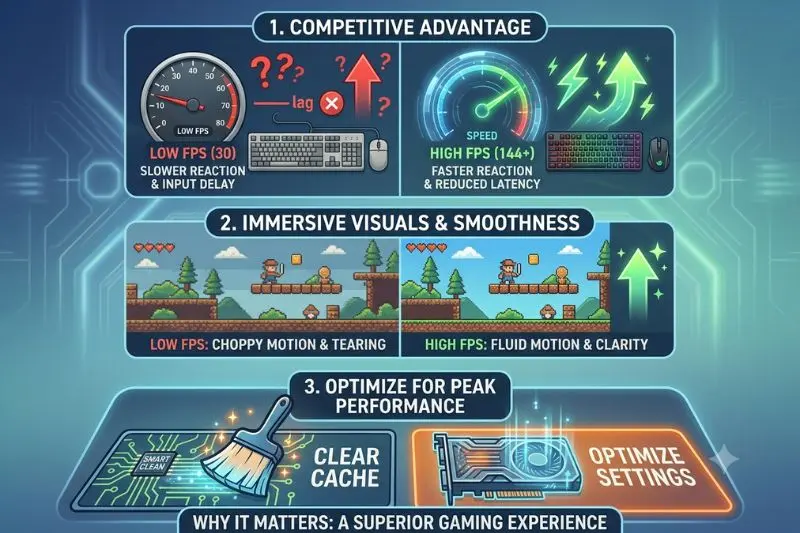
Higher FPS isn’t just about prettier gameplay. It provides several real-world benefits.
Better Responsiveness
Games respond more quickly to your keyboard and mouse inputs.
Smoother Visual Experience
Animations become fluid, reducing motion blur and screen tearing.
Competitive Advantage
In multiplayer games, higher FPS can improve aiming, tracking enemies, and reaction time.
Reduced Stuttering
Stable frame rates eliminate annoying performance hiccups.
Better Hardware Efficiency
Proper optimization allows your PC to perform closer to its maximum potential.
Detailed Step-by-Step Guide
Step 1: Update Your Graphics Drivers
Graphics drivers play a huge role in gaming performance.
Manufacturers regularly release updates that improve:
- Game optimization
- Bug fixes
- Stability
- FPS improvements
Before playing newly released games, always install the latest graphics driver compatible with your GPU.
Step 2: Lower Graphics Settings
This is one of the fastest ways to increase FPS in any PC game.
Reduce settings such as:
- Shadow Quality
- Ambient Occlusion
- Anti-Aliasing
- Reflection Quality
- Texture Filtering
- Volumetric Lighting
Start with Medium settings and adjust based on performance.
Step 3: Lower the Resolution
Higher resolutions require more GPU power.
Examples include:
- 4K
- 1440p
- 1080p
- 900p
- 720p
If your PC struggles, lowering the resolution can dramatically increase FPS.
Step 4: Enable Performance Mode
Many games include graphics presets.
Choose:
- Low
- Medium
- Performance
- Competitive Mode
These presets reduce unnecessary visual effects while maintaining enjoyable gameplay.
Step 5: Close Background Applications
Background programs consume CPU, RAM, and storage resources.
Close unnecessary apps such as:
- Web browsers
- Streaming software
- Cloud synchronization
- Music players
- Large downloads
This frees system resources for your game.
Step 6: Disable Startup Programs
Too many startup programs slow Windows.
Disable unnecessary startup apps through Task Manager to improve overall performance.
Step 7: Turn On Windows Game Mode
Windows includes a built-in Game Mode.
It helps by:
- Prioritizing game processes
- Reducing background activity
- Improving resource allocation
Many gamers notice smoother gameplay after enabling it.
Step 8: Select High Performance Power Plan
Balanced power plans may reduce CPU performance.
Switching to High Performance allows your processor to maintain higher clock speeds during gaming.
Step 9: Install Games on an SSD
Solid State Drives load game assets much faster than traditional hard drives.
Benefits include:
- Faster loading
- Less texture pop-in
- Reduced stuttering
- Better open-world performance
Although SSDs don’t always increase average FPS significantly, they improve overall responsiveness.
Step 10: Increase Available RAM
Modern games often recommend:
- 8 GB minimum
- 16 GB recommended
- 32 GB for heavy multitasking
If your system frequently runs out of memory, upgrading RAM can reduce stuttering.
Step 11: Keep Windows Updated
Windows updates often include:
- Performance improvements
- Security patches
- Better hardware compatibility
Avoid ignoring important system updates.
Step 12: Monitor CPU and GPU Temperatures
Overheating causes thermal throttling.
When temperatures become too high, your CPU or GPU automatically reduces performance.
Use monitoring software to check temperatures while gaming.
Step 13: Clean Dust from Your PC
Dust blocks airflow.
Regular cleaning helps:
- Lower temperatures
- Improve cooling
- Maintain stable FPS
- Extend hardware lifespan
Clean fans every few months.
Step 14: Disable Unnecessary Visual Effects
Windows animations consume small amounts of system resources.
Disabling unnecessary effects provides slightly better performance, especially on older computers.
Step 15: Upgrade Your Hardware
If software optimization isn’t enough, consider upgrading:
- Graphics card
- RAM
- SSD
- CPU
Prioritize the graphics card for the biggest FPS improvements.
Step 16: Use Performance Monitoring Tools
Performance overlays help identify bottlenecks.
Monitor:
- FPS
- CPU usage
- GPU usage
- RAM usage
- Temperatures
Knowing what’s limiting performance helps you make smarter upgrades.
Step 17: Adjust In-Game Advanced Settings
Some settings impact FPS more than others.
Lower these first:
- Shadow Distance
- Motion Blur
- Depth of Field
- Bloom
- Screen Space Reflections
- Particle Effects
You may notice minimal visual differences but significant FPS gains.
Step 18: Keep Enough Free Storage Space
A nearly full drive can reduce system responsiveness.
Maintain at least 15–20% free storage for optimal performance.
Benefits of How to Increase FPS in Any PC Game
Optimizing your gaming PC offers several advantages:
- Smoother gameplay
- Faster response times
- Reduced lag
- Better competitive performance
- More stable frame rates
- Improved system efficiency
- Longer hardware lifespan through better cooling
- Enhanced gaming experience
- Reduced input delay
- Better use of existing hardware without immediate upgrades
Disadvantages / Risks
Although optimization is generally safe, there are a few considerations:
- Extremely low graphics settings may reduce visual quality.
- Overclocking can increase heat if done improperly.
- Incorrect driver installations may cause temporary issues.
- Closing important background applications could interrupt downloads or updates.
- Aggressive performance tweaks may reduce battery life on gaming laptops.
Most basic optimization methods carry very little risk when performed carefully.
Common Mistakes to Avoid
Many gamers unknowingly reduce their PC’s performance by making avoidable mistakes.
Ignoring graphics driver updates
Old drivers may prevent games from running efficiently.
Running too many background programs
Extra applications consume valuable resources.
Using maximum graphics settings
Ultra settings often provide minimal visual improvement while significantly lowering FPS.
Never cleaning the PC
Dust buildup increases temperatures and causes throttling.
Ignoring overheating
High temperatures reduce performance over time.
Installing games on slow hard drives
Older HDDs may increase loading times and cause occasional stutters.
Skipping Windows updates
System updates often improve hardware compatibility.
Believing every optimization tool
Some “FPS booster” programs promise unrealistic results and may even harm system performance.
What FPS is considered good for gaming?
For most players, 60 FPS provides smooth gameplay. Competitive gamers often aim for 120 FPS, 144 FPS, or even higher.
Does more RAM increase FPS?
More RAM mainly helps if your system currently lacks enough memory. Upgrading from 8 GB to 16 GB often improves overall gaming performance and reduces stuttering.
Does lowering graphics settings increase FPS?
Yes. Lower graphics settings reduce GPU workload, allowing your computer to render more frames each second.
Can an SSD improve FPS?
An SSD primarily improves loading speeds and reduces stuttering. Average FPS gains are usually small, but overall gameplay feels smoother.
Is overclocking safe?
Overclocking can improve performance if done carefully with proper cooling. Beginners should research thoroughly before attempting it.
Why is my FPS suddenly dropping?
Common causes include:
Background applications
Driver problems
Overheating
Windows updates
Hardware limitations
High graphics settings
Identifying the bottleneck is the first step toward solving the issue.
Should I upgrade my GPU or CPU first?
For most gaming-focused systems, upgrading the graphics card provides the largest FPS improvement. However, if your CPU is consistently maxed out, a processor upgrade may be more beneficial.
Can internet speed affect FPS?
No. Internet speed affects online latency (ping), not frame rate. FPS depends on your computer’s hardware and game settings.
Expert Tips & Bonus Points
Want to squeeze even more performance from your PC? Keep these expert recommendations in mind:
- Restart your computer before long gaming sessions.
- Avoid running unnecessary browser tabs while gaming.
- Keep graphics drivers updated regularly.
- Monitor temperatures to prevent thermal throttling.
- Enable technologies like DLSS, FSR, or XeSS if your hardware supports them, as they can boost performance while maintaining good image quality.
- Use full-screen mode instead of borderless window mode when possible.
- Defragment traditional hard drives (but never SSDs).
- Ensure your power supply provides stable power to all components.
- Upgrade your monitor only after ensuring your PC can consistently deliver higher frame rates.
- Test one setting at a time so you can clearly see which changes improve performance.
Small improvements may seem insignificant individually, but together they can produce a much smoother and more enjoyable gaming experience.
Conclusion
Learning how to increase FPS in any PC game doesn’t have to be complicated or expensive. While high-end hardware certainly delivers better performance, many FPS problems can be solved through smart optimization, updated drivers, proper graphics settings, and regular PC maintenance. Even older computers often have untapped potential that can be unlocked with a few simple adjustments.
Start by updating your graphics drivers, lowering demanding graphics options, enabling Windows Game Mode, and closing unnecessary background programs. Keep your PC clean, monitor temperatures, and ensure your operating system stays up to date. If your system still struggles after these optimizations, upgrading key components such as your graphics card, RAM, or SSD can provide a substantial improvement.
Remember that every game is different, so don’t be afraid to experiment with settings until you find the right balance between image quality and performance. The goal isn’t always to achieve the highest possible FPS, but rather to maintain stable, consistent frame rates that make gameplay feel smooth and responsive.
By applying the techniques covered in this guide, you’ll be well-equipped to optimize your gaming setup, enjoy better performance, reduce frustrating lag, and get the most value from your PC for years to come.
